


The word comes from the Greek palimpsestos, meaning “scraped again.” It described a practical act, the reuse of scarce writing material. Parchment was costly. Words were expendable. So old texts were washed or scraped away to make room for new ones. The Archimedes Palimpsest, discovered in a thirteenth-century prayer book, contained mathematical treatises from the third century BC hidden beneath liturgical text. What was erased survived. What replaced it became the mask.
The concept extends far beyond manuscripts. Geologists read landscapes as palimpsests, where glacial scars run beneath modern river systems. Architects encounter it in buildings renovated across centuries, where Tudor beams hide behind Georgian plaster. Cities themselves are palimpsests. Dig beneath any European street and you find Roman foundations, medieval middens, layers of habitation pressed into the earth like pages in a book that was never finished.
A Painting That Remembers
The Disappearing Man is a palimpsest made of paint, paper, charcoal, thread, crystal, and more than two centuries of human attention.
The work began as a watercolour on paper. Over two decades, Milo layered gouache, charcoal, cotton thread, crystals, a red jewel, and stone into its surface. He also scraped, burned, cut, and sanded it. The paper endured this for years until its fibres began to fail. It split. It buckled. It started turning to dust.
To save it, Milo mounted the paper onto a wooden panel. That panel already carried its own finished artwork, an independent charcoal drawing made years earlier. Two separate works, made at different times for different reasons, were pressed together into a single object.
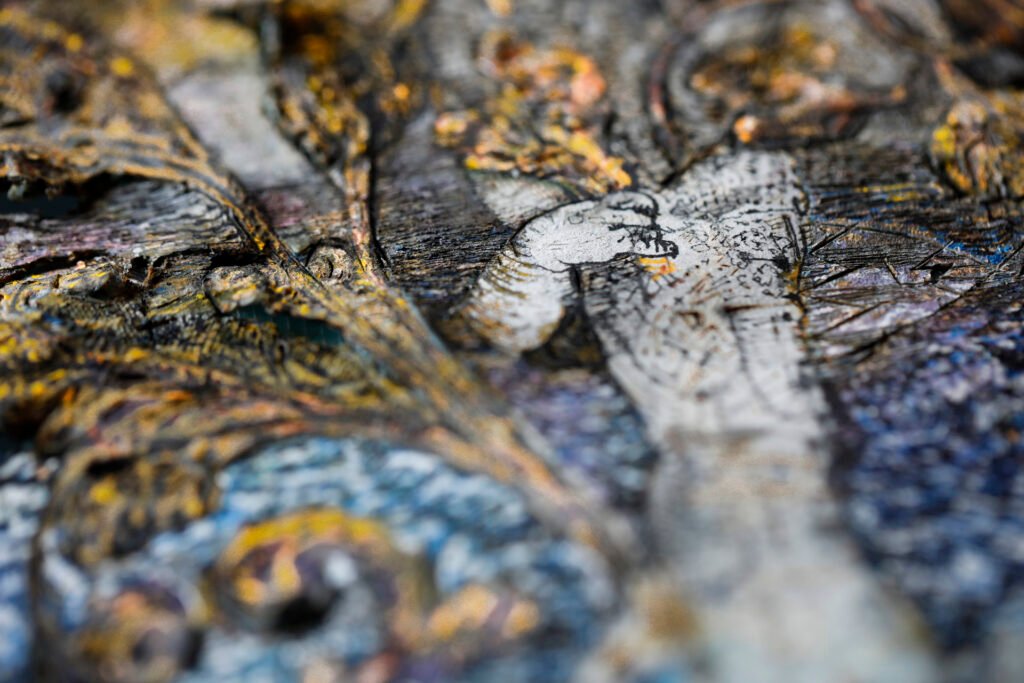
Then something unexpected began. The front surface continued to deteriorate. Gouache flaked. Paper thinned. And through the growing gaps and worn patches, the charcoal drawing on the panel beneath started to show through. The older image, the one that was supposed to be hidden, began reappearing.
The work is a living palimpsest. One image fades while another emerges. The act of destruction becomes an act of revelation.
Overworking as Method
In conventional painting, overworking is a mistake. It means the artist pushed past the point of resolution, muddied the colours, lost the freshness. Teachers warn against it. Galleries expect sleek finished surfaces.
Milo’s practice inverts this entirely. Overworking is the method. Layering, scraping, burning, sanding, repainting, carving, gouging, staining, and layering again. A single passage of the image may have been painted and destroyed dozens of times. Each cycle deposits residue. Pigment settles into grooves. Burn marks darken old brushstrokes. The history of the work accumulates in the material itself.
The Disappearing Man carries many years of this accumulation. Every inch of its surface holds traces of earlier states, colours that were painted over, forms that were scraped away, textures that were burned and then repainted and then burned again. The image you see today is the topmost layer of a deep archaeological site.
The Figure Between States
The man in the painting is tall and faded. His head dissolves into the sky above him. His feet vanish into water below. He stands in that threshold between presence and absence, visible and gone.
His right arm has been replaced by a crystal with a blue ring. Flesh became mineral. A red jewel hangs at his genitals, suspended by cotton thread that breaks through the picture plane. A small devil descends on strings from above, pulling at him like a marionette. Behind his legs, a child’s hand grips a vine. The child’s body stays hidden.
Dense botanical scrollwork fills the lower half of the composition, acanthus leaves and tangled growth rendered in ochre and burnt sienna. A stone or mountain pushes upward through the centre. The natural world flourishes as the human figure withers away.
The man is caught between arriving and leaving. The beast beside him, a yellow creature with a human expression, materializes with the same force that the man loses. One presence fills the space vacated by another. The painting holds both movements simultaneously.
Deterioration as Dimension
Most artworks are preserved against time. Conservators stabilize surfaces, control humidity, replace varnish. The goal is to hold the object in a fixed state, as close to the artist’s original intention as possible.
The Disappearing Man refuses this. Its deterioration is part of its meaning. The paper crumbles. The backing warps. The edges remain ragged and unprotected. The object changes every year.
This aligns with the Buddhist concept of Anicca, the principle that all compounded things are impermanent. Nothing holds its form. The painting performs this truth physically. You can return to it season after season and find it altered, a little more of the front surface gone, a little more of the charcoal drawing showing through.
The two images, front and back, occupy different temporalities. The gouache painting belongs to the present, vivid and deteriorating. The charcoal drawing belongs to the past, monochrome and emerging. They move toward each other through the slow collapse of the material that separates them. Eventually they will merge completely.
Why Palimpsest Matters Now
We live surrounded by palimpsests we rarely notice. The digital kind are everywhere. Every edited document, every revised post, every overwritten file is a palimpsest with its previous versions stored or lost. The difference is that digital palimpsests hide their history. You see the current version. The old ones require forensic tools to recover.
Physical palimpsests do the opposite. They show you everything at once. The old bleeds through the new. The erased resurfaces. Time becomes visible as texture, as damage, as ghost.
The Disappearing Man makes this process radically transparent. You can see the layers. You can see what’s coming through. You can see that the object is in motion, changing as you stand in front of it, even if the change is too slow for the eye to catch in a single viewing. The painting asks you to understand that what you are looking at is temporary. The image you see today will be different next year. The one after that will be different again.
A palimpsest is a record of change. A surface that remembers. In The Disappearing Man, the figure fades but the work, built from decades of accumulated gestures, proves that nothing made with attention ever fully disappears.